

 Anyone reading fantasy and science fiction knows that the genre is dominated by series. From my end of the business, series are both a pleasure and a curse. Once you get the look of a series down, its continuation is relatively easy for me -- so many decisions are already made, the type, the artist, the tone. I get a few new details and basically sit back and let the artists work. When a series starts off looking good, it usually sails along nicely, but then, of course, the reverse can be true as well. If you don’t hit the mark on the first go you set up a sizable hurdle for the following books. Unfortunately that means rather conservative decision making up front. While I may want to try out a new artist, I don’t always feel comfortable committing to 3, 6, 12 books with someone that I have never worked with before. Not always, but often enough, I tend to stick to the guys that I already have proven relationships with. This, in turn, often leads leads to scheduling conflicts down the line -- an inevitable alignment of stars and planets will end up with a bunch of one artist’s titles in the same catalog season. I’m glad for the ease of some series, and when they go well I really enjoy seeing the paintings as a collective whole, but I can't help but to wish we had more stand-alone books and different points of view to explore.
 I asked a few artists what they felt about working on series titles:
"Series are cool because it gives you a chance to fill out the world you're building in some more detail. I also feel more connected to my character after several portrayals. It can be a shackle when the marketing crew is sure that a particular portrayal is responsible for selling the book. It's best when the AD gives you latitude to be able to show the world from a different view each time. I also think that the tendency to "brand" authors with a single artist can make the biz of illustration tougher. Instead of book assignments, you have series assignments, and that makes the ebb and flow of work more extreme. Your flow is also greatly effected by how prolific your authors are, and that can vary enormously." DAVE SEELEY
"From an artist's standpoint its quite nice. You become familiar with the characters. That means less time worrying about accuracy and more time developing story." DAN DOS SANTOS
“A series is a good thing if you're an artist. You want the books to look good and do well, so you'll get the next one--that's the pragmatic, economic reason--but you're challenged to keep the series fresh, which forces you to think about the approach, to try to see things from different perspectives. Even a series has to have variety and flow. It's a restraint that can help you to grow. It also lets you explore a direction more than once. A series of books can become a collection of paintings, each with a slightly different flavor.” TODD LOCKWOOD
“Series are neither harder nor easier to undertake, as I approach each and every commission as a new start. The goal of each image is to convey a compelling representation of the content of the book, and considering the variations most authors place on the content of their novels, I do not see how it is possible to use the same approach every time. For me, continuity in a series, if there is any, tends to be more formally based than anything related to design.
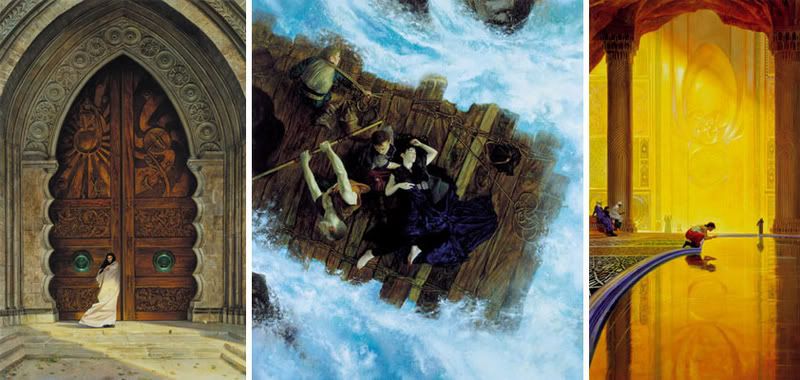
One of my most successful series was for Isobelle Carmody, where the unifying factor was the scale of the figures to their architectural environment, and the passage of time 'through' the images: the beginning of the journey; the journey; and the final recuperation/rejuvenation. Each image stands alone and has very little, in terms of design, to do with the others. As a painter, I look to challenge myself and find new ways to reinterpret similar content without appearing too incestuous within my style.” DONATO GIANCOLA
Shown here are some series that I enjoy seeing as a unified body of work:
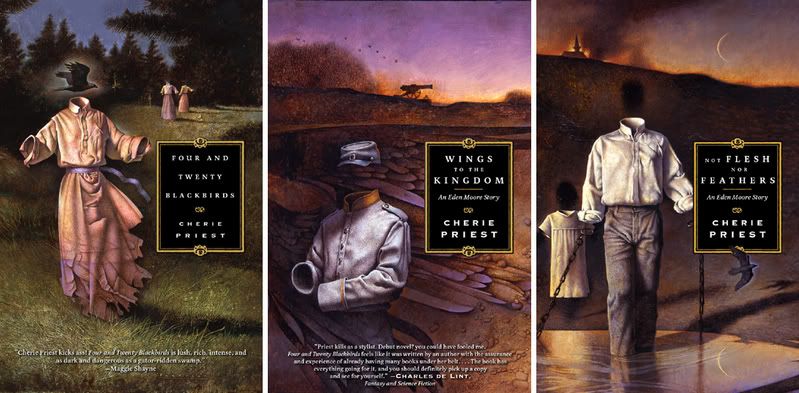
John Jude Palencar’s “Eden” novels. I think Wings to the Kingdom is one of my very favorite paintings.
Dan Dos Santos' Alosha Trilogy. Coincidentally, the girl on Yanti is the spitting image of our fabulous paranormal-romance editor Anna Genoese.
Dave Seeley Elizabeth Moon novels from Del Rey.
Donato Giancola and the Tor covers for the Obernewtyn Chronicles
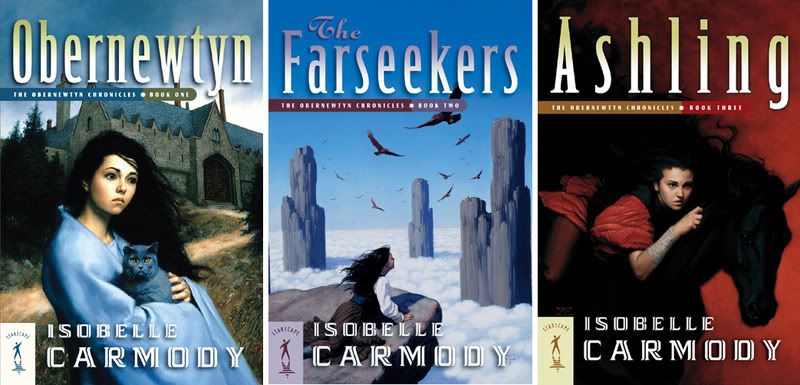
Tristan Elwell and the Starscape editions of the Obertnewtyn Chronicles
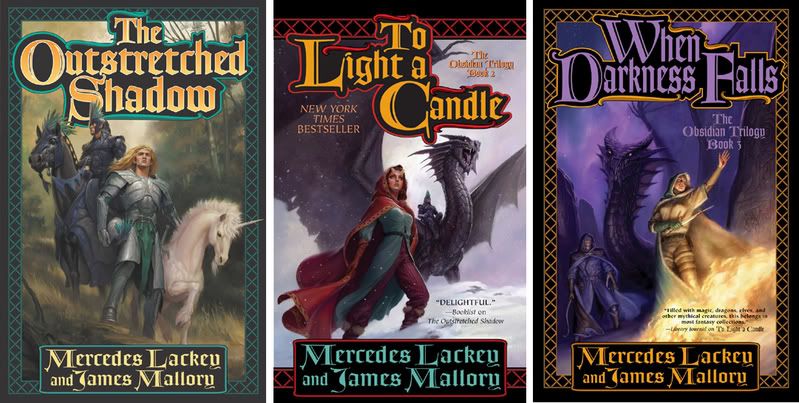
Todd Lockwood and the Obsidian Trilogy
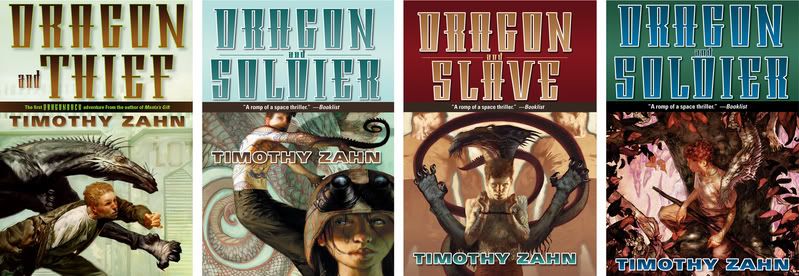
Jon Foster and the Dragonback novels.